Friday, August 5, 2016

Am I holding their hands or holding them accountable?

File:Parent-left child-right yellow-background.svg
By Ezra Katz (File:ParentChildIcon.svg) [CC BY-SA 3.0 (http://creativecommons.org/licenses/by-sa/3.0)], via Wikimedia Commons

I have had quite an adventure with my ninth graders this year! I think that I have learned more from them than they have from me...or perhaps just as much.

There is a lot of debate regarding homework: some believe that it should no longer be assigned because students' home lives are such that homework isn't a priority and assigning it is penalizing them. Others (myself included) contend that homework serves useful purposes: reviewing material outside of class, practicing skills, developing independence and responsibility.

I try to make the homework short, worthwhile, focused, attainable. For my 9th graders, a typical homework assignment can be completed in 5-15 minutes. It may be the ONLY time that they actually "study" material outside of my class.

But, homework completion was at an all-time low this year, with only 1 or 2 students completing each assignment. Many students regularly forgot, lost it, or didn't care to try. They were not worried about a grade penalty either--my 9th graders didn't care what grades they got, even if they failed.

So, I began an experimental "accountability activity". Each day when I collected assignments (and I increased the number of assignments, but kept them very short), I would spend 10 minutes checking their work. If a student did not hand in the assignment, turned in a partially completed assignment, or made mistakes on more than half of the questions, I wrote a note to be delivered to them in homeroom the next day.

The note required that they come and see me. If they had a study hall during the day, the note was a pass to come to my room during that period. If they had no study hall, they came during homeroom. They came. I instructed them to complete the assignment. They did. I checked it immediately. When their homework was satisfactory, I signed their pass and let them return to study hall, homeroom, or the next period.

At first they came, angry and resistant. I was firm, but not aggressive or confrontational. "When you complete the assignment fully and correctly, then you can leave". It could take two minutes, or it could take half an hour. One young man was so angry that he couldn't (or wouldn't) speak to me or look at me. But he completed the assignment easily, spending only a few minutes and consulting his notes only once or twice. When he finished and gave me his paper, I looked him in the eye and said, "I believe in you more that you believe in yourself, and I am not going to let you be less than your best!" (or something like that).

The first few weeks were a discouraging battle. It seemed to make no difference, and it seemed that the students were not learning any good habits or responsibilities.

But then...


  • students started to trickle into my room before school, verifying homework assignments, asking questions, handing in their work early (gasp!);
  • students began to come to my room during their study hall period, sometimes staying to complete their homework there;
  • students began to talk with each other about homework, both holding each other accountable and becoming a personal pep squad;
  • students' grades overall improved as they finished their assignments, and their quiz/test/project grades improved as well;
  • students learned how to tutor and coach each other, not sharing answers, but helping to understand concepts;
  • students began to read the daily posted agenda and look for assignments;
  • our classroom became a community, a family as it were, and they sought to help each other and please me!


Never would I have dreamed that the results would prove this exciting!

But some educators will ask, "Aren't you holding their hands?"

...perhaps I am. Or,


  • Perhaps I am leading them in the path of responsibility;
  • Perhaps I am showing them the value of work done well;
  • Perhaps I am modeling for them habits that they can use in all their classes and in the workplace, both now and in the future;
  • Perhaps I have given them a safe way to try again, and provided an option other than excuses for shoddy work;
  • Perhaps I have taught them how to learn for themselves, work as a team, and coach/tutor peers;
  • Perhaps I have given them value, purpose, respect, responsibility, trust;
  • Perhaps I have offered them a chance to be part of a loving, protecting family.


Am I holding their hands, or holding them accountable?


Wednesday, January 13, 2016

Turning Corners in My Teaching Career

Sebastian Ballard [CC BY-SA 2.0 (http://creativecommons.org/licenses/by-sa/2.0)], via Wikimedia Commons https://upload.wikimedia.org/wikipedia/commons/c/c2/Curves_in_Ashwood_Way_-_geograph.org.uk_-_1033645.jpg

I have to admit that somewhere in my teaching career I turned a corner. Twice.


It’s not that I don’t love Spanish any more; I love language and the logic behind it. I love discovering new words and connections to other words, and I love when the lights come on for students. Teaching Spanish is fun!

At some point, I realized that I love teaching. It doesn’t matter the subject (gasp), I just love helping others learn. And I think it shows. It’s exciting and I like to share that excitement. Reading books, attending training sessions, reading educator and administrator blogs, listening to other teachers-all of these are thrilling and inspiring. I love to learn new ways to teach, and I love to experiment. Teaching is fun!


In an ideal world, I can go to work each day and have the time of my life. There are new lessons to craft, and old lessons to tweak. My “unread bookshelf” is full and I am reading any number of books all at the same time.

Back in the real world, some days aren’t as awesome as others. At times I go home discouraged, tired and overwhelmed, and I need to distance myself from it, at least for a time.

It’s not that I don’t love teaching any more; I still love to teach. There is a thrill in implementing a new idea, in stretching myself to grow through failure or success, and in helping my students to do the same.

But, I’ve realized that I have turned another corner.

I love my students. I love each of them, regardless of yesterday, today, or tomorrow. 


Love is a choice, like my career. I choose to love them; it is my decision to make. 


Love is a calling, like my career. I am called to love them; it is my responsibility to do it.


What sends me home depressed at the end of the day? An unsuccessful lesson? No. A grammar error I made? No. A jam in the copy machine. No.

It is the relationships. I share in my students’ joys and sorrows. I worry about them, grieve over them, celebrate with them, and sometimes communicate my frustration to them. I want to see each of my students become a man or woman of honor, to choose what is right over what is convenient, to take responsibility for himself or herself.

Their success or failure is not ultimately up to me. But I have a role to play. I can believe in my students. I can show them the right way. I can challenge them to care and to dare.

I love when I hear from or about my former students:
  • one is in medical school;
  • two are pursuing doctorate degrees in the sciences;
  • several have graduated from Ivy League schools;
  • one has graduated from the Naval Academy;
  • three former students now teach in our school district;
  • one is currently serving with the Peace Corps in Paraguay;
  • one is in graduate school to become a Spanish teacher (awesome!);
  • several serve in the military;
  • many are raising families;


But there are other stories:
  • my students often move away (transience is a large issue in our school);
  • some students bounce in and out of classes, or in and out of cyber, alternative, and public school;
  • at least three of my former students went to prison from high school;
  • many of my former students dropped out of high school;
  • at least five of my former students have died from alcohol, drug use, careless accident or suicide;
  • more than a dozen of my former students have had criminal charges against them, and many continue in that lifestyle.


It can be very discouraging.

But I cannot give up.


My students today have not made their choices.


I do not know the future.


Therefore, I choose to love today. I cannot fix their yesterday, but I can help with today, and I can invest in tomorrow.


The choice is theirs, but I am going to be the best coach, encourager, parent, teacher that I can.


I choose to love. 

Teaching comes second. 

Spanish comes third.

I choose to love! 


Which students most try your patience?

In what ways can you demonstrate belief in those students?

How can you find encouragement on the long and discouraging days?


<Note: I wrote the blog and published it previously (12/13/15) at bkurtzlifelonglearn.blogspot.com.>


Wednesday, January 6, 2016

"Happy" is a Choice


My last class of the day is Spanish 1. It's really small, just 14 ninth graders. During class each day I try to make sure that I speak repeatedly with each of them, both about class topics and about personal ones. As class began on the first day after Christmas vacation, I circulated the room checking materials (more on this in a subsequent post), and inquiring about the students' vacation and current condition.

Carmen still hasn't let down her guard and doesn't fully trust me yet. Sometimes I see a little relaxing, but most of the time her defenses are high, her answers are terse, and her attitude is combative. When I approached her desk, she showed me her materials, handed me two late assignments, and asked,

"Why are you always so happy?"


Quickly I responded, "I love my job and I love my students. Why wouldn't I be happy?"

She shook her head and didn't say anything back to me, though when I walked away I heard her recalling grumpy teachers from her past.

Two days later, the question is still ringing in my ears. Why am I always so happy? I have a lot of answers, mostly borne out of knowing who I am, understanding that I am called to teach, and believing that I have been gifted to do this job. But there is something more:

"Happy" is a Choice.


In today's society, "emotions" are given the right to run lives. People make "snap" decisions, make and break relationships, react and overreact, and allow their emotions to determine what kind of day and attitude they have.

Emotions CANNOT drive our lives. We must employ our minds and bring our emotions under control. It is possible to "BE" happy without "FEELING" happy.

When I begin each of my classes, I deliberately choose to begin with a positive attitude. I choose to greet my students in an uplifting manner, regardless of what he or she might have done the day before. (*Disclaimer: I have had days when I did not present a positive attitude; but students will remember the way things usually are.)

I am not always happy. Some days I struggle with debilitating headaches, and on other days I am sad, worried, angry, frustrated, preoccupied, etc. But I CHOOSE to be happy. And usually my choices actually impact my feelings, and I am happy.

Some of my students live in a whirlwind of emotional choices and reactions. They don't reign in their emotions, and they don't experience family or friends doing this either. It is yet another part of their lives that lacks any self-control.

Perhaps my consistency will impact some of them. Perhaps I need to find a way to explain it to Carmen, and to my other students. Could I convince them that "Happy" is a choice? How can I teach them to choose their emotions? 

Do you rule your emotions or do your emotions rule you?

In what ways have you chosen to override your emotions and present a positive attitude to your students?

How might your consistency in emotion benefit your students?


Wednesday, December 16, 2015

I Will Not Sink

I will not sink.

  • I will participate in positive, professional dialogue.
  • I will not seek a platform for attention based on negativity or mudslinging.
  • I will avoid listening to gossip about others, and I will not repeat it if I hear it, nor will I give credence to it.
  • I will attempt to turn negative conversations to other topics by injecting a positive insight or suggesting a new topic of conversation.
  • I will walk away from conversations if I cannot participate conscientiously in them and if I cannot effect change.
  • I will seek to find the positive in all situations and people.
  • I will seek conversations and relationships that will focus on growth and positive situations.
  • I will not hide my struggles, but I will address them with honesty and humility, and I will not use my struggles as occasions to harm others.


I will not sink.

    Why is it so much easier to talk about negative things? Why are we attracted to the negative: criticism, complaining, gossip? I think it makes us feel better about ourselves, or superior to others, and we like that.


    Why do conversations focus on negative items far more often than positive ones? A young teacher and I were talking. I told her that we had a great job and that we had a lot of good students. She stopped me there and told me that she doesn’t hear this anywhere else. Her colleagues were always negative, always critical, always focused on the down side.

Isn’t that a sad statement?

    I have been drawn to Twitter as a great source of professional development and encouragement. I have made clear boundaries for myself. I will not participate in negative or critical discussions. I will be honest about my struggles as a teacher, in order to grow and help others grow, but I will not be negative or argumentative. I will not sink. If people I follow begin to Tweet negative, critical comments, become argumentative, or advocate base discussion, behavior or language, I “unfollow” them. I will not sink.

    When I was student teaching my cooperating teacher told me, “Stay away from the faculty room”. I didn’t know what he meant. Then we went down for lunch a few days. The teachers gathered there chose to spend thirty minutes criticizing their spouses, their children, their colleagues, their administrators, and their students. I left depressed. Is this how it always is? No, sometimes I could hear gossip. <Disclaimer: not ALL faculty rooms are like this, and not ALL teachers in faculty rooms are like this--I am generalizing--using an example with which many people can relate.>

So I ask: What will you do to keep from sinking? 


  • Will you participate in positive, professional dialogue?
  • Will you not seek a platform for attention based on negativity or mudslinging?
  • Will you avoid listening to gossip about others, and not repeat it if you hear it, nor give credence to it?
  • Will you attempt to turn negative conversations to other topics by injecting a positive insight or suggesting a new topic of conversation?
  • Will you walk away from conversations if you cannot participate conscientiously in them and if you cannot effect change?
  • Will you seek to find the positive in all situations and people?
  • Will you seek conversations and relationships that will focus on growth and positive situations?
  • Will you not hide your struggles, but address them with honesty and humility, and not use your struggles as occasions to harm others?


What if we try it together? What if we drown out the negative with positive? What if we incorporate professional dialogue into our profession? What if we find the positive and celebrate that? What if we walk away from the negative? 


I will not sink.


Thursday, December 10, 2015

Letter to Lorenzo

Dear Lorenzo (y amigos),   

  I am hoping that today I can start you thinking about how you can help yourself and others, just by thinking about what you are doing and why you are doing it. Before you begin, I want to make sure that you know that I really like you and think that you are intelligent, funny and pleasant to be around. I don’t mind your restless energy, and I understand that by the end of the day you’re feeling pretty restless from 7 ½ hours of sitting down.


     My problem is that you use your restless energy to distract and often hurt others. When you speak loudly, especially when it’s across the room, you keep people from being able to concentrate. If you move around the room, other students are distracted from their tasks. When you move, take, destroy or alter other people’s items, you communicate that you think you’re more important than they are, that they are somehow beneath you, and that simply is not true. 


I've tried and tried to find a way to channel his energy.

He's bright, funny, pleasant and always energetic. By the end of the day when he arrives at my class, he needs to move, needs to release some energy, needs to talk and interact. He is too tall for sitting comfortably in the desks.

I don't mind. I encourage him to stand up, to stretch, to be involved in activities. I'll ask him to get something for me from a cupboard or to take something to the office.

I try to teach him how to channel his energy and humor in a positive direction. I know that he works well with regular attention, eye contact and positive feedback. I also know that he responds well to humor and to clear, direct speech.

Some days it seems like we are making progress. I thank him. I tell him that I appreciate his attention, participation, focused energy.

Other days we slide back a little. Sometimes I am more frazzled after 42 minutes with him than with my entire day. It's not that I don't like him, I do. He is very easy to like.

Monday he couldn't or wouldn't direct his energy toward anything productive; instead, he moved around, took people's things, distracted them from their work. Lorenzo kept his peers from being able to enjoy class activities, and he took away their voice when he took away their vote.

I tried several redirecting activities. I attempted to speak to him personally about his activities. But I was not successful and left school that day discouraged.


    I want all my students to know that they are a valuable part of my class, and I want all of them to find success. That includes you. That includes your friends. That includes the quiet students and the talkative students, the angry students and the happy students, the hardworking students and the not-so-hardworking students. 


As I am sure is true with many teachers, I am quick to let the emotion rule the mind. "I'm such an awful teacher." "I am not effective at classroom management." "I shouldn't be doing this job." "I shouldn't be mentoring new teachers." On and on the negative comments come.

The truth is, however, that I am NOT an awful teacher, I AM effective at classroom management, I SHOULD be doing this job. I am a teacher. I love what I do and I love my students, even the troublesome ones. Especially the troublesome ones.

After time away, a good night's sleep and some reorientation through morning devotions, I hatched a plan.

An EVIL plan (hear my diabolical laughter?)


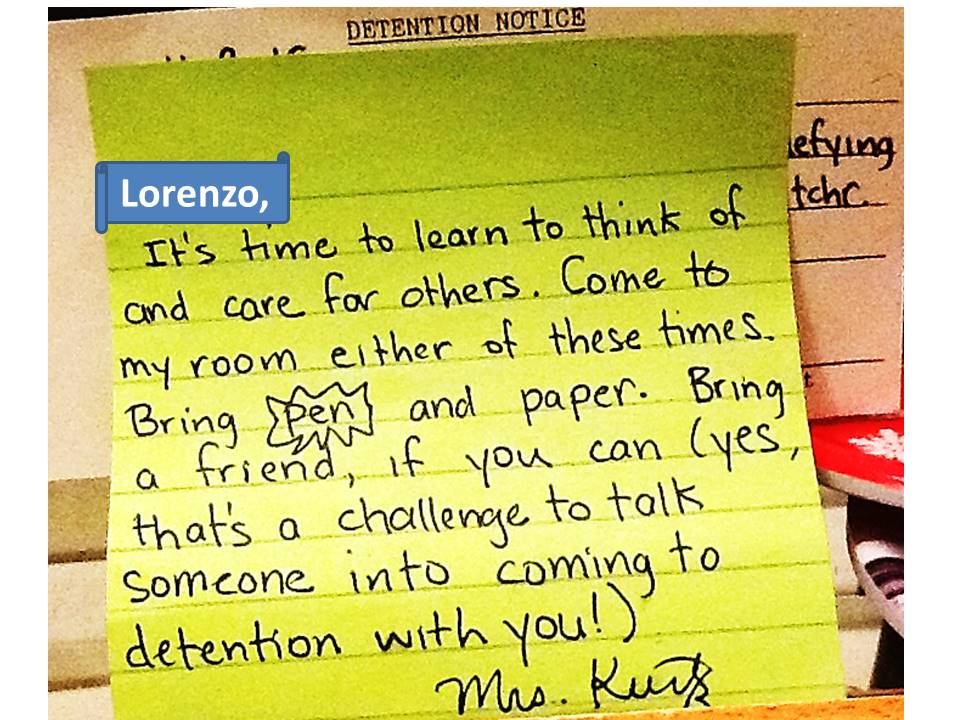
The next day I sent Lorenzo a detention slip and a note to his homeroom.


He came quickly to my room laughing, "Can I really bring my friends?" I told him that I would love for him to bring as many friends as he could. He got excited, and through the day a few students told me that they were going to come to detention with Lorenzo. In the end, however, Lorenzo told his friends that they didn't have to come, and he attended detention by himself.

When Lorenzo came the following day after school, I greeted him with a letter (the purple parts of this blog are the contents of his letter). There are so many important things to communicate; how do I capture his attention and help him understand?

You have incredible potential! You can be a top student, a leader in the school, a role-model, and a friend. It’s time to dig deep and find in yourself the strength to choose what is right. I know that you can!


With the help of a colleague and one of Lorenzo's friends and teammates, we provided an unique detention experience.


    Before you leave today, you need to write a letter of appreciation to an adult who believes in you, who challenges you to greatness, who pushes you to do what is right. That can be a family member, a teacher, a coach, a neighbor.  


     Your letter needs to be written in CURSIVE and in INK. It should include:·         a greeting (Dear ____);
·         the reason you are writing (I’m writing this to say thank you…);
·         at least two things for which you are grateful to this person;
·         a positive character trait that you see in them and would like to see in yourself;
·         one idea for how you will try to be like this person;
·         another “thank you”;
·         your name
When your letter is satisfactory to me, you may leave.With all my respect and best wishes,


Lorenzo took a few moments to read my letter and looked up with laughter. Yes, I affirmed, you must write a letter. Who has been a big influence in your life? It took a while because he did not want to do this. I helped him to think of someone, and then I told him that his detention would only last as long as it took to write the letter.

Just as Lorenzo was beginning, my colleague arrived and asked, "Lorenzo, what are you doing here? What are you doing? Can I read this?" On and on it went. He took the paper from Lorenzo, pointed out errors, bumped his hand while writing, kept him distracted.

Then, to make matters worse, Lorenzo's friend Tito arrived and started interrupting him as well. "Lorenzo, what are you doing? Can I read it? Oops, I accidentally wrote on your paper. Oh, well (balling it up), you'll just have to start over".

My colleague and Lorenzo's friend demonstrated for him what I could never adequately express with words. We need to regard each other with respect; we need to treat each other with courtesy; we need to channel energy into productive and not destructive actions.

Yes, this was a little diabolical, I admit. 


I wouldn't try this with every student.

But I know Lorenzo. I need to be unconventional in reaching him; I need him to see how what he sees as "humor" can be a distraction and a detriment if improperly used.

Lorenzo has a great sense of humor. He laughed the entire time (about 25 minutes).

In the end, after several drafts, Lorenzo wrote a very sweet letter to his older sister. He wrote it on "official" stationery, addressed an envelope and sealed the letter inside.

We reviewed the facts: Lorenzo is personable and capable. He's also funny and social. All of those can be tremendous assets, or they can be weapons. He has a choice to make on a daily basis. I know that not every "tomorrow" will be smooth because of today, but I hope that I have made a long-lasting impression for him.

I waited a few days and then mailed the letter home. I also mailed him a postcard, affirming my belief in him and encouraging him to choose wisely and to continue to shine. I also sent his mother a note, telling her how proud of Lorenzo I was.

Takeaways:

At first I was so frustrated with Lorenzo that I couldn't think rationally, and I was beating myself up for my lack of "classroom management". Not reacting at the time was the best choice.

When you face classroom management battles, 

how can you give yourself time to reflect, 

rather than react in the moment?


I needed a creative way to reach Lorenzo, but this is not a formula for success for any student and any situation. I knew Lorenzo, and I had established a rapport with him.

What creative methods have you used

to attempt to reach a student?


My battles are not over. Lorenzo will have good days and bad days. I need to continue to believe in him, and continue to push him to greatness.


When you have a student who seems 

"incorrigible,"

 will you commit to

 believing in him or her anyway?


Embedded image permalink
A local printer makes my post cards.


Wednesday, November 18, 2015

Three Truths...No Lie!

Today I am celebrating truthfulness. On three separate occasions within the span of just a couple of days, students chose to do what is right instead of what is convenient.

After reading the poem "Instantes," (here is a Spanish version: https://www.youtube.com/watch?v=JeDGMllnGYE) students had to interview three adults and record what the adult would do differently if he/she could return to a younger age. We discussed the answers aloud, each students sharing what their interviewees would have done.

"I would have studied to become a doctor."
"I would have played a sport in high school."
"I would not have sold my Mickey Mantle baseball card."

The discussions were enjoyable, and the students freely shared their responses. I congratulated and thanked them all.

After class, Charlie remained behind. "Señora, I forgot to do the assignment. I made up the answers based on what I think my parents would have said. And I remembered my grandfather telling me about the baseball card he had sold."

Charlie chose to confess the truth without prompting, regardless of the cost, because it was the right thing to do.


At the end of another class, Alex asked to talk to me. "Señora, I think you made a mistake in the grade book. You gave me more points than what you had on the rubric."

Alex chose to reveal a truth that would have been better and more convenient to have kept hidden. He is a hardworking student in a hardworking, competitive (class rank) class. Alex did it because it was the right thing to do.


Early in the morning on the weekend I received an email from Mike. He was disappointed at his grade for the first quarter and he wondered what had gone wrong, or what he could do. It would be his first "B" ever in a Spanish class, and he had missed an "A" by one percent.

I emailed him back, thanking him for emailing with the question, and telling him that I, too, was disappointed because I felt he could have done better. But, I offered him a "lifeline". "Please look back at the project rubric in your Google Drive folder. There are two sections where you have a very low score. Read over them and then let me know honestly if I have made a mistake. If so, I will adjust your grade."

A few hours later, Mike emailed me again. He wrote, "Señora, I see what I didn't do. I didn't share with or correct anyone's slide show...I never found time...I apologize for not paying closer attention to the details of the project and putting enough time in."


Mike chose to admit to a difficult truth, knowing that he was sacrificing a chance at a higher grade because it was the right thing to do.


Moments like these don't make the evening news; they aren't headlines in the paper either. But perhaps they should be. Wouldn't that be a refreshing change of pace?

So, what are my takeaways from these experiences?

  1. Truth and integrity still exist. Never, never, never give up or grow cynical. 
  2. Always believe in and encourage the best in your students.
  3. Some days this job is so incredible I feel like I should be paying to do it! 

I need to celebrate my students' honesty and integrity. Perhaps I should share the stories with my students and colleagues, but I need to do so in a way that does not embarrass them. That will take some creative thinking.

What stories keep you believing in your students?
How can you celebrate acts of truthfulness and integrity?
How have you demonstrated truthfulness and integrity before your students? your colleagues?


Tuesday, November 10, 2015

Taking a Walk with my Students

On Wednesday I decided that I needed to spend a little time one-on-one with some students. Although it was difficult for me to detach myself from all the "URGENT" tasks on my desk, I gathered student schedules and went for a walk.

They were some of the most well spent minutes of my week!


First stop: I borrowed Rosa from her computer class and we went for a walk. Rosa was so agitated in class the day before that she came without her materials, would not work or participate, and became combative with other students over minor interruptions. My statement to her was, "I was worried about you because you were so upset, and I wanted to make sure that you are okay. Is there anything I can do?"

Quickly, Emily shared concerns weighing on her, concerns that we would dismiss as "9th grade girl syndrome," but in her world, real, emotional, critical.

I didn't have any answers but I asked how I could help. Emily asked to have her seat moved. Easily done!

That day I moved Rosa. Thursday, Rosa was early to class, had her materials, completed her assignment, and participated in the class activities. She proudly showed me that she was ready for class, and I thanked her for her effort.

Second stop: Tito and I walked around a hallway while we discussed his abrasive comments to a fellow student in class the day before. I made sure that I understood he did not begin the conflict, but that he was incited by a comment I didn't hear. Then I asked if he was okay, considering that another student had insulted him. He assured me that he and the other student were "cool," they were just joking around.

Third stop: Julio was the other student involved in the harsh exchange of words. As we walked through the hall, he echoed Tito's sentiments. We discussed the potential harm of his comments, and he agreed that they were wrong. He apologized and I walked him back to class.

When Tito and Julio came to class that day, they took the time to speak with each other about everyday types of things. I think it was mostly to prove to me that their relationship was good. I was pleased and relieved.

The clock was ticking down, but I had one more student I really wanted to contact.

Fourth stop: I borrowed Lorenzo from his study hall and we went for a walk. We strolled casually around part of the school and then found a bench in the hallway where we could sit and talk. I have some suspicions: Lorenzo causes trouble because he has my class at the end of the day, because he is too tall to sit comfortably in the classroom desks, because he loves to speak and joke without thinking through what he is saying, because he is bored and not challenged enough.

Yes, he agreed each time. Then we talked about solutions.

More than anything I want him to know that I care. I want him to succeed. I like him as he is; he doesn't have to alter his personality to be likable. I believe in him. I will help him find ways to succeed.

It's okay to move to a desk separated from others so there is room to stretch; it is okay to stand up or move around a bit; it is okay to talk and joke with friends, at the right time and in the right way. Let's work out what those things look like.

When Lorenzo came to class today, we moved his seat and found moments when he could stretch and move. We implemented some other changes. Truthfully, everything isn't "perfect," but that's okay. We work on it together. Tomorrow he's coming for a detention and we're going to have a hands-on, movement and task-oriented time. I even challenged him to bring a friend with him.

So, what are my takeaways from the day?

  1. Students have stories. I can't assume that I know already, I need to listen.
  2. Walking around the school is far less intimidating than meeting at a desk or in an office. The students seem less defensive and more willing to talk.
  3. I need to guard my students' dignity and identity; they are not criminals, delinquents, or objects of my wrath. 


I need to take more walks with my students, whatever the reason. I will try to make this a regular practice!

How do you build relationships with students?
How can you address concerns with students while affirming their value and your belief in them?
What demands keep you "tied to your desk"?
Will you consider taking a walk with a student today?


And Slightly Beyond!

  And Slightly Beyond! This year I have a lot of eager, motivated students in my Spanish classes. I feel like I am constantly saying to them...